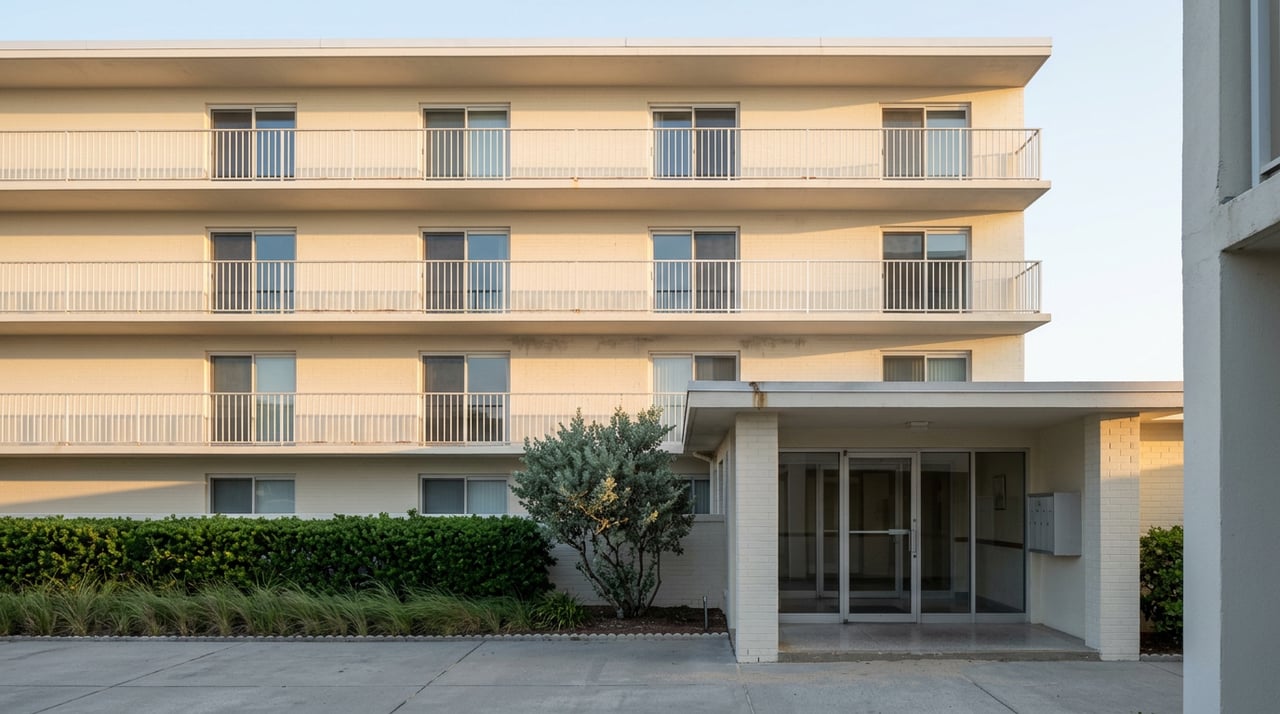
Same View, Different Mortgage: What's Changing for Long Beach Oceanfront Buyers
August 27, 2026
August 27, 2026
Two buyers walked into contract on Long Beach oceanfront units within the same week this August. Both units face the water. Both are one-bedroom layouts with a private terrace. Both list for roughly the same price. One buyer is closing on schedule in five weeks. The other just found out her lender needs another month, maybe two, because of a form she has never heard of called a condo questionnaire.
The difference has nothing to do with either apartment. It comes down to what kind of building each one sits inside, and a lending rule that took effect on August 3, 2026.
For as long as most Long Beach buyers can remember, the shorthand was simple. Co-ops are the hard path: a board package, an interview, a higher down payment, sometimes a rejection with no explanation required. Condos are the easy path: a deed, a standard mortgage, and a lender who mostly cares about your own finances rather than the building's.
That shorthand still holds some truth. Co-op boards can still ask for two to three years of tax returns, bank statements, and reference letters, and they can still say no without giving a reason. But the "condos are easier" half of the equation just got a lot less reliable, and it happened almost overnight.
On August 3, 2026, Fannie Mae and Freddie Mac eliminated Limited Review, the simplified underwriting path that roughly 65 percent of condo loans nationally had been using, according to reserve study firm Strategic Inspections. Every established condo project now goes through Full Review, which means a lender examines the building's budget, its reserve funding, its insurance, its delinquency rate, and any pending litigation before your loan can close. A second change lands January 4, 2027: the minimum reserve fund requirement rises from 10 percent to 15 percent of a building's annual budgeted assessment income. Buildings that have been funding reserves at the old floor now have a matter of months to close the gap or risk losing eligibility for conventional financing altogether.
Co-op share loans are untouched by either change. That part of the market keeps running on its own rules.
These rules trace back to the 2021 Surfside condo collapse in Florida, and the buildings drawing the most scrutiny are exactly the vintage that lines Long Beach's oceanfront: multi-decade-old structures that were built before anyone was thinking about 30-year capital plans. Sea Pointe Towers, the 10-story condominium at the boardwalk, was completed in 1987. Blue Point, on West Broadway, is a true condominium with common charges typically running $600 to $800 a month and taxes on at least one recent unit landing near $19,500 a year, roughly $1,625 monthly. Add those together and a buyer is looking at somewhere around $2,225 to $2,425 a month in building and tax costs before the mortgage payment, homeowner's insurance, or a flood policy even enter the picture.
That is the kind of building the new Full Review process is built for. Older infrastructure, salt air, decades of deferred maintenance decisions. None of that means a specific building will fail review. It means a buyer should now ask the question before writing an offer rather than finding out from a stalled lender three weeks before closing.
Meanwhile, several of the most recognizable buildings on the same strip are actually co-ops, and the new reserve rule does not apply to them at all. Seaview Terrace, the seven-story building at 560 West Broadway completed in 1972 in the Westholme section, is a co-op with 85 units. Long Beach Terrace, on the eastern end of the boardwalk with its circular driveway and art deco facade, is a co-op too. Neptune Towers, at 25 Neptune Boulevard, carries one-bedroom maintenance around $1,644 a month, a figure that already folds in the building's share of taxes and most operating costs. None of these three buildings will be measured against the 15 percent reserve threshold, because that test is a condo-specific rule.
Here is where it gets genuinely confusing for a buyer doing their own homework online. Oakwood Apartment Corp, a seven-story building one block from the beach completed in 1962 with 114 units, is structured as a cooperative corporation, the way its name suggests. Yet more than one listing portal describes it as a "condominium building." If the platforms buyers use to browse listings cannot consistently keep the two structures straight, it is worth assuming the listing description in front of you is not the final word. The proprietary lease, the offering plan, and the building's own financial statements are the documents that actually answer the question, and that is true whether you are looking at Oakwood, Seaview Terrace, or any other building on the list.
Recent listings show how differently these buildings run in practice. A co-op unit at 750 Shore Road, listed for sale in January 2026, carried a monthly assessment of $329.17 through the end of 2025, with subletting allowed after two years of residency. A co-op at 360 Shore Road, listed for sale in June 2026, carries a monthly assessment of $753 through February 2027 and requires board approval to rent, along with a $750 non-refundable application fee and $500 move-in and move-out fees. Two co-ops, two very different cost pictures, and neither one touched by the reserve rule reshaping the condo side of the market.
| Building | Type | Era | What a buyer sees |
|---|---|---|---|
| Sea Pointe Towers | Condo | 1987 | Full Review required as of Aug. 2026 |
| Blue Point | Condo | Recent construction | Common charges roughly $600-$800/month |
| Seaview Terrace | Co-op | 1972 | 85 units, oceanfront, Westholme section |
| Oakwood Apartment Corp | Co-op | 1962 | Sometimes mislabeled "condo" on portals |
| Neptune Towers | Co-op | Established | ~$1,644/month one-bedroom maintenance |
| Long Beach Terrace | Co-op | Established | Board-approval rental process |
For a condo, ask the listing agent or the managing agent whether the building's reserve study has been completed within the last 36 months and whether it recommends the highest funding level rather than a bare-minimum baseline. Both are now required for a condo to stay eligible under the new guidelines. Ask what percentage of the annual budget currently goes to reserves, since anything below 15 percent by January 2027 becomes a real risk to your ability to get a conventional loan, not just a board's problem to solve later. Ask whether the building has gone through Full Review before, since a building with no track record there may take longer than expected.
For a co-op, the homework looks different. Ask for two years of board minutes and the current operating budget, since thin reserves or an unusual maintenance jump often show up there before anywhere else. Ask about the building's underlying mortgage, since your share of that debt gets built into your monthly maintenance whether or not you ever think about it again. Ask what the board's post-closing liquidity expectation is, since some buildings want a year or more of housing costs sitting in cash after your down payment clears.
Either way, the smart move in this market is asking the question before you're under contract, not after your lender comes back with a list of documents nobody warned you about.
Does this change affect buyers paying all cash? The Fannie Mae and Freddie Mac rules govern conventional loan underwriting, so a cash purchase sidesteps the reserve and review requirements entirely. It does not sidestep the building's actual financial health, which is worth checking regardless of how you're paying.
Is a co-op automatically the safer choice now? Not necessarily. Co-ops avoid this specific rule, but they carry their own risks, including underlying building mortgages and board discretion that can be just as costly to misjudge. The right structure depends on the building, not a blanket rule about co-ops versus condos.
When does the 15 percent reserve requirement actually take effect? For loan applications dated on or after January 4, 2027. A buyer applying for financing before that date falls under the current 10 percent standard, so timing your application matters if a building is close to the line.
Long Beach's boardwalk has never been a one-size-fits-all market, and this fall it is less forgiving than usual of buyers who assume every oceanfront building works the same way. If you are weighing a unit at Sea Pointe Towers against one at Seaview Terrace, or trying to figure out why one deal is moving faster than another, Lucky To Live Here can walk you through what each building's financials actually say before you put down a deposit. Contact Us to start with a building-by-building conversation, not a generic one.

Best Holiday Eats On Long Island

Seasonal
The best picks on the Island


Community
Labor Day Weekend Events on Long Island

Community
Lucky To Live Here® Team at SERHANT
Lucky to Live Here Realty is built on the skills, passions, and track records of top selling Real Estate Agents who call Long Island home. Known for their community driven efforts, strong social presence, innovative marketing, and wealth of knowledge about the local Real Estate market.

LUCKY TO LIVE HERE AT SERHANT.
129 Main St Cold Spring Harbor, NY 11724